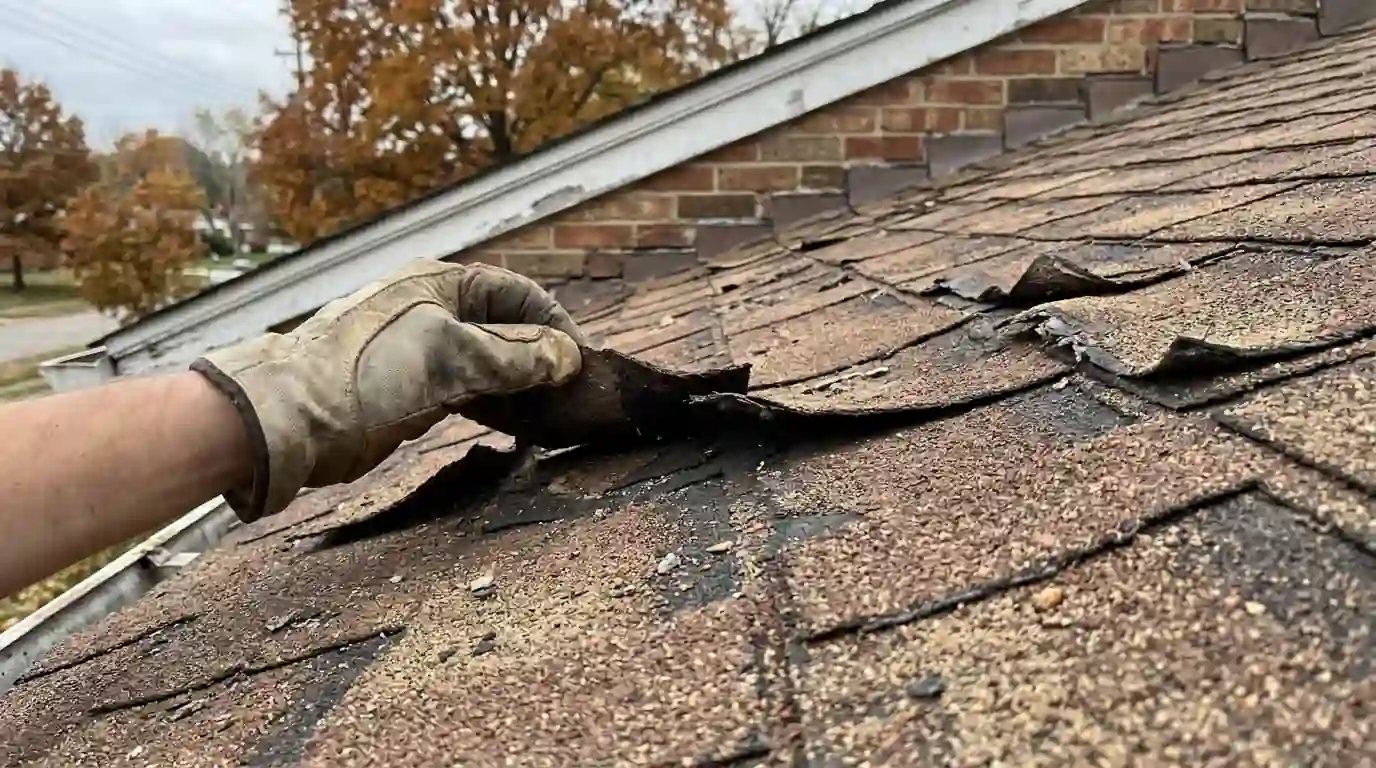
Repair makes sense when the roof is under roughly 15 years old, the problem is local (a pipe boot, a flashing joint, a few blown shingles) and the shingles still bend without cracking. Replacement makes sense when granule loss, curling or brittleness show up across several slopes, when there are already two layers, or when repairs keep stacking up season after season.
Start with the roof's age and the shingle you actually have
Age isn't the whole answer, but it frames everything else. A lot of Dayton-area homes still carry three-tab shingles installed in the late 1990s or early 2000s. Those were often sold as 20 or 25 year products, and in our climate they tend to wear out a bit sooner. Architectural shingles installed in the last 15 years are thicker and usually have more life left in them.
If you don't know when the roof went on, check your closing papers, ask a neighbor who's been on the street a while, or look for a permit record with your city. The answer changes how we think about every repair. Spending $640 on a 7 year old roof is easy to justify. Spending $640 on a 23 year old three-tab roof is often money you'll wish you had put toward the replacement.
Where the leak comes from matters more than how many there are
Most leaks we trace in the Miami Valley don't come from the shingles at all. They come from the joints: cracked rubber pipe boots, rusted step flashing along a sidewall, a chimney where the counterflashing pulled loose, or a valley where two slopes dump water together. Those are repairable on almost any roof, because the fix is local and the surrounding shingles don't need to be disturbed much.
Field failure is different. When water gets through the middle of a slope, it usually means the shingles themselves have lost their seal or cracked. One spot like that might be storm damage. Three or four scattered across different slopes usually means the roof is reaching the end, and patching it becomes a guessing game.
Timing gives you a clue too. A leak that only drips during wind-driven rain from the west usually points to flashing or a lifted shingle edge on that side. A stain that grows after snow melts points toward the eaves or a valley. A leak that shows up in every steady rain, regardless of direction, is more often a failed seal or a cracked shingle in the field. Keep a short log of dates and weather, and we can usually narrow the source down before anyone climbs up.
Signs the whole roof is telling you it's done
Our crew lead looks at the roof as a system, not just at the spot that leaked. These are the patterns that push us toward recommending replacement:
- Granule loss across most slopes, with bare black patches and gutters full of grit.
- Shingle edges curling up or the middles cupping down, especially on south and west slopes.
- Shingles that crack instead of bending when we lift a tab on a cool morning.
- Two existing layers, since residential code used in Ohio doesn't allow a third.
- Soft or spongy spots underfoot, which point to decking damage below.
- Daylight or water stains on the attic side of the roof boards in several places.
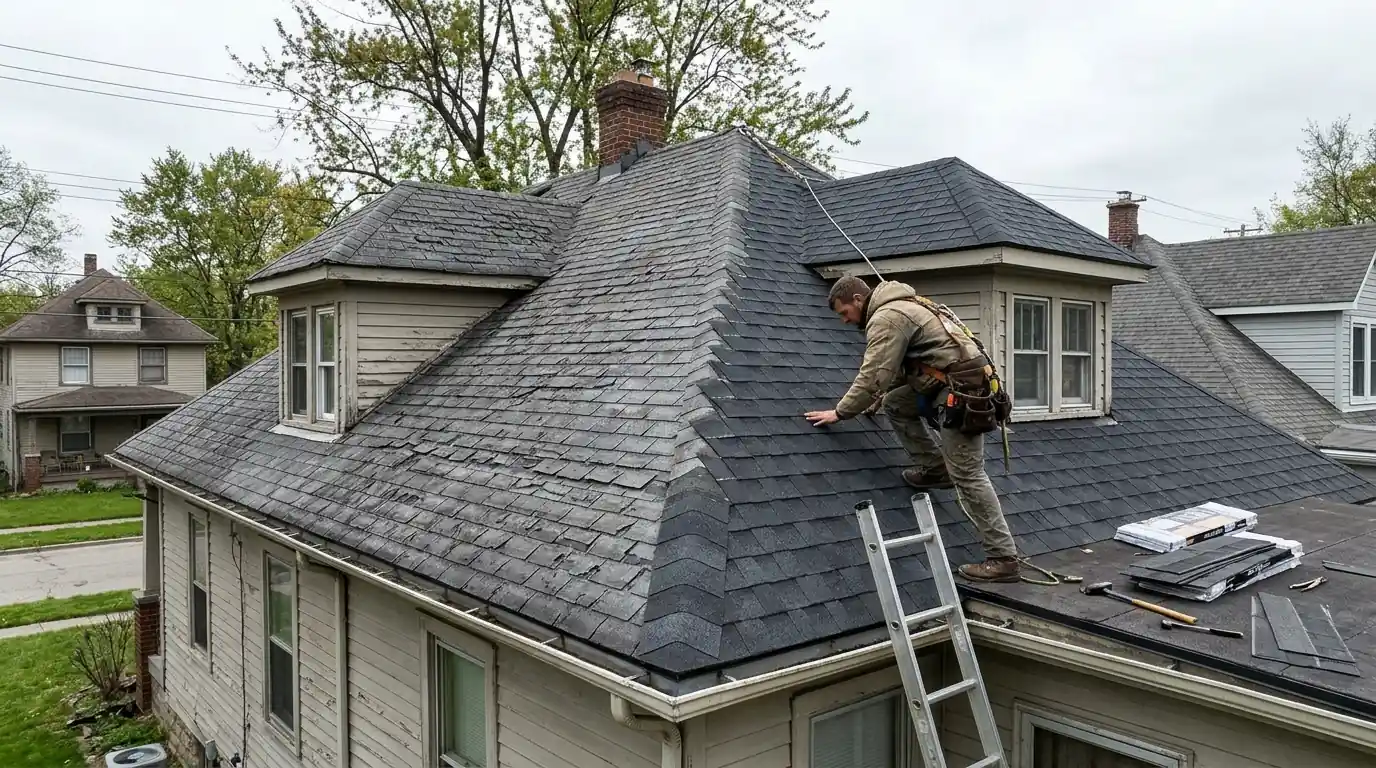
Running the numbers on a typical Dayton home
Here's what the two paths typically cost around Dayton in 2026. These are ranges, not quotes, and pitch, access and what we find under the shingles all move them. Replacing a failed pipe boot usually runs $245 to $485. Resealing or rebuilding step flashing along a wall or chimney typically falls between $385 and $1,240. A storm repair with a dozen or so shingles commonly costs $465 to $1,180.
A full tear-off and replacement on a typical 1,800 to 2,400 square foot home with architectural shingles commonly lands between $11,650 and $19,480. Tearing off a second layer usually adds $1,350 to $2,870, and replacing rotted decking tends to run $78 to $135 per sheet installed. Our roofing calculator can give you a rough starting figure for your own house.
The rough test we use: add up the repairs you can reasonably expect over the next three years. If that total starts approaching a quarter of the replacement cost, and the roof is past about 18 years, replacement usually wins. Below that line, a good roof repair is the smarter spend, and we'll say so.
How Ohio's seasons change the timing
Repairs can happen in almost any weather. We tarp and patch roofs in January when we have to, because a leak doesn't wait for spring. Planned replacements are a different story. Shingles seal best when the sun warms them, so late spring through mid fall is the easiest window. We can install in colder weather, but we hand-seal more of the tabs and watch the forecast closely.
That makes a practical middle path possible. If your roof is borderline in November, a careful repair can carry it through the freeze-thaw months, and you can plan the full roof replacement for April or May with time to compare bids. What we don't recommend is nursing a clearly failing roof through two or three more winters, because that's when water quietly rots the decking and the final bill grows.
Selling, insuring and other wrinkles in the decision
If you plan to sell within a couple of years, a buyer's home inspector will note the roof's age and condition, and an old roof often becomes a negotiating point. Sometimes a replacement before listing pays for itself. Sometimes a repair plus documentation is enough. We can walk you through which one fits your market and your timeline.
Insurance is shifting too. Some carriers writing policies in Ohio now pay older roofs on an actual cash value basis, meaning depreciation comes off any storm payout. Others decline to renew homes with roofs past a certain age. Call your agent and ask how your policy treats a roof of your age, because that answer can tip a close decision. If you'd like a clear-eyed view first, a roof inspection gives you photos of every slope and our plain recommendation. Our article on how long Ohio roofs typically last covers lifespans by material if you're weighing an upgrade.