Wind Damage Roof Repair in Dayton, OH
Wind rarely takes a whole roof. It creases tabs, breaks seal strips and peels ridge caps, then the next gust takes more. We fix the damage, find out why it let go, and send photos of every repair.
- Answered 24/7
- Photo report on every visit
- Dayton and the Miami Valley
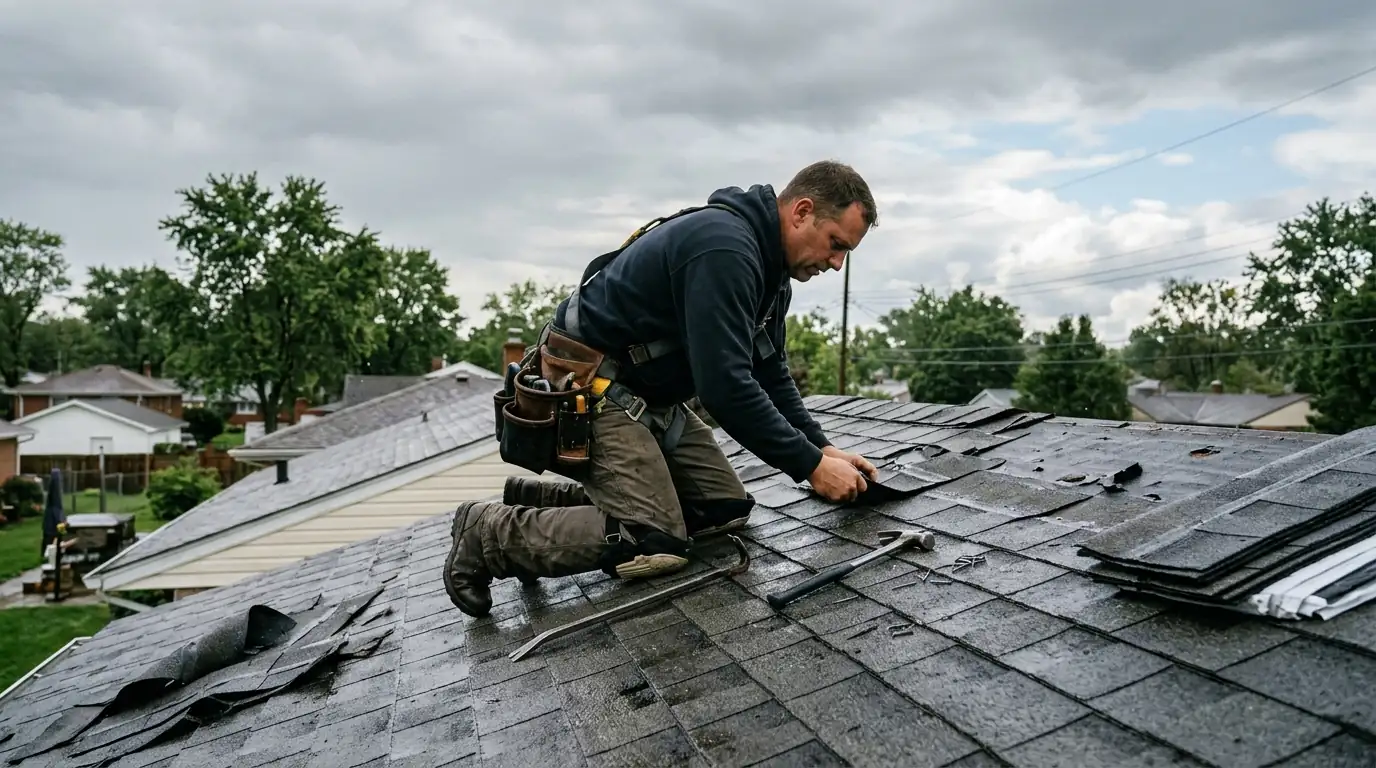
Wind damage repair on a Dayton-area shingle roof typically costs $265 to $1,690, depending on whether we're resealing lifted tabs, replacing creased shingles, rebuilding a ridge or re-securing a rake edge. Larger losses that cover most of a slope run $2,780 to $5,940. Every repair includes checking the nailing and seal strips nearby, because wind damage usually spreads from a weak spot.
Shingles are designed to lie flat and bond to each other. Each one has a strip of sealant that softens in the sun and glues it to the course below, and four to six nails holding it to the deck. When wind gets under an edge that never sealed, or one whose bond has aged out, it lifts the tab, bends it back and creases the shingle across the nail line. Once that happens, the shingle may still be on the roof, but it is no longer doing its job.
That's the damage most people miss after a windstorm. Missing shingles are obvious; creased ones are not. We look for both, along with stripped ridge caps, loose rake edges and torn starter strips, the spots where wind typically gets its first grip. A good wind repair replaces what is broken and fixes the reason it failed, so the same row doesn't lift again in the next spring storm. If the storm also brought hail or a falling limb, see our storm damage roof repair page for the full claim process.
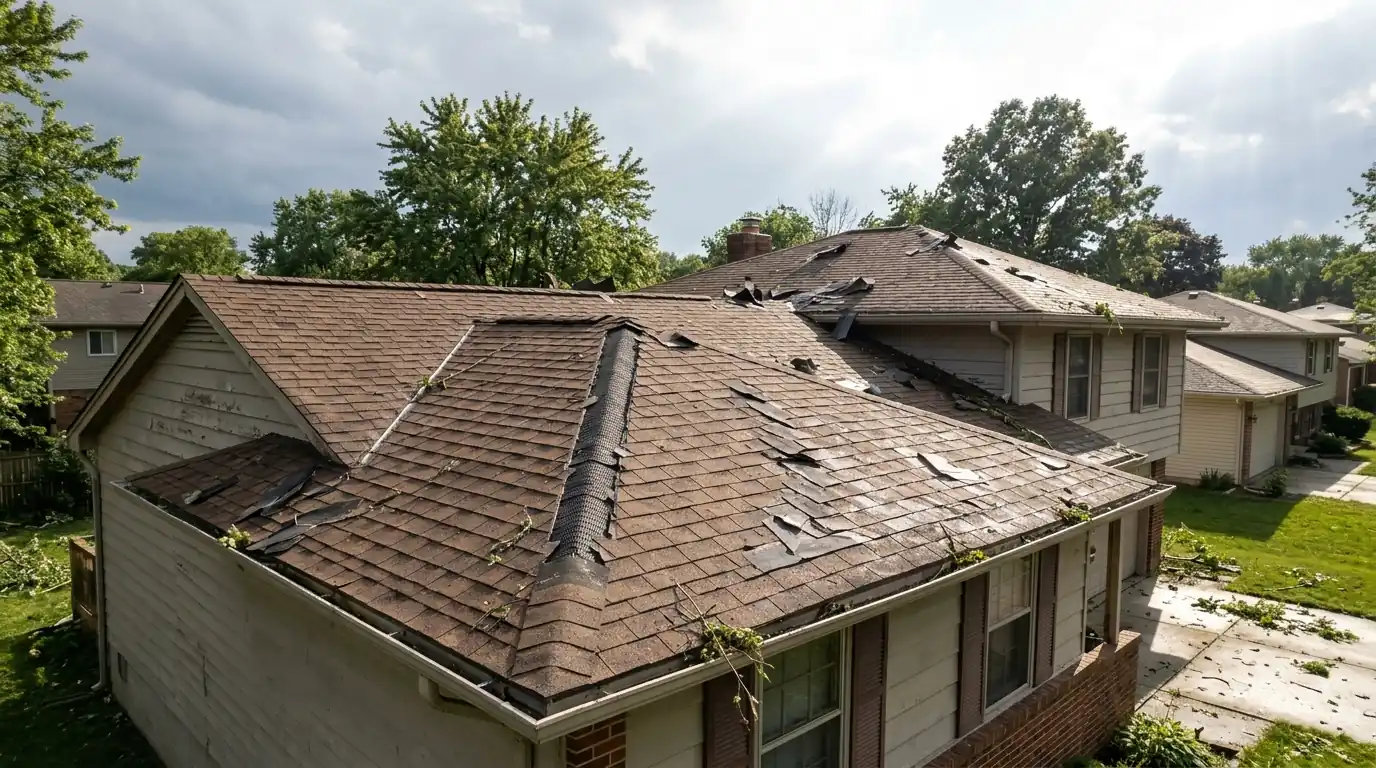
Creased tabs, lifted rows and other marks wind leaves on a roof
Some wind damage is obvious from the yard. The rest shows up as lines, shadows and small changes in how the roof lies.
A horizontal line across shingle tabs
A crease where the tab bent back and fell into place again. The mat is broken there, and the tab will tear off in a future storm.
Rows that look wavy or don't lie flat
Seal strips that let go leave shingles sitting loose on the course below. From the street, the roof looks rippled in low sunlight.
Bare or missing ridge cap shingles
The ridge takes the strongest wind on the roof. Missing caps expose the ridge vent or the top of the deck to rain.
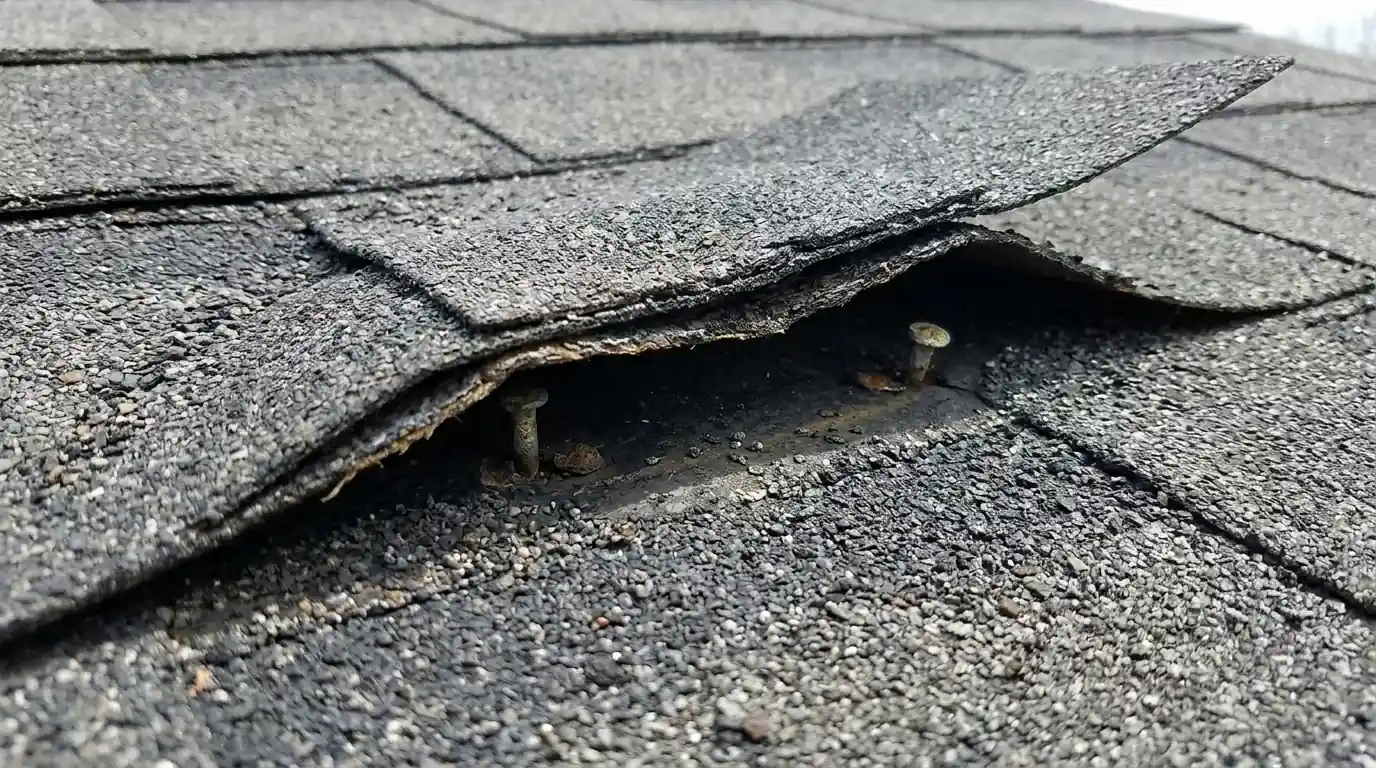
Exposed nail heads or torn nail holes
When a shingle pulls over its nails, the holes are left open and the next course can lift more easily.
Loose edges along the gables
Rake edges without a proper starter course or drip edge flutter in the wind and peel back toward the field.
Shingle pieces in the gutters or yard
Whole tabs, or strips of the sealant edge, mean material came off the roof even if the gap isn't visible from below.
How we repair wind-lifted shingles so they hold the next gust
Wind repairs succeed or fail on the details. Here's how our roofers fix wind damage and the cause behind it.
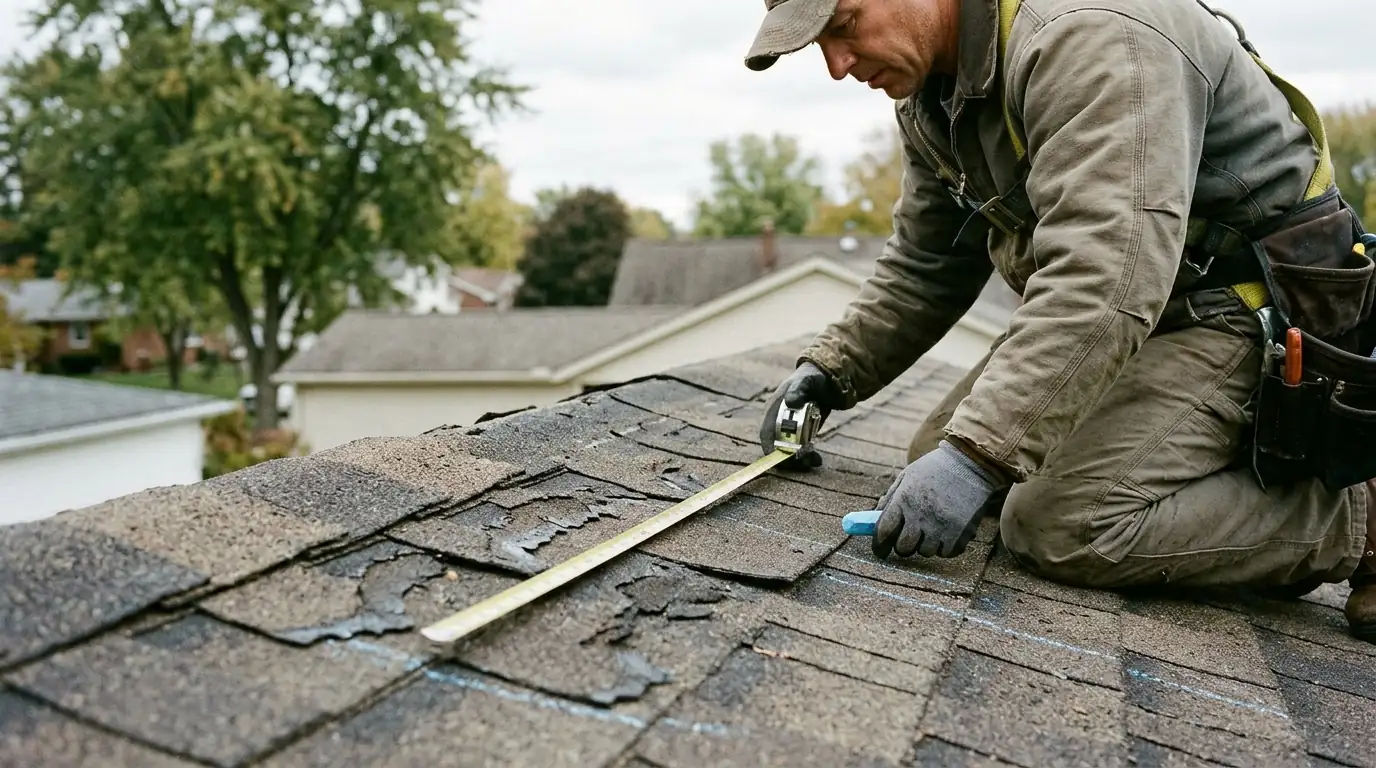
Lift-test the rows around the damage
We gently test the shingles near every damaged spot to see which ones are still sealed and which are loose. Wind damage almost always extends beyond what's visibly missing.
Check the nailing pattern
We pull a few shingles to see where nails were placed and how many. High nailing above the manufacturer's line is a common reason shingles blow off, and it changes how we repair the area.
Replace creased and torn shingles
Creased shingles come out and new ones go in, matched as closely as possible. We never just glue a creased tab down, because the broken mat will tear again.
Hand-seal loose tabs that are still sound
Shingles that never sealed but aren't damaged get dabs of compatible roofing sealant under each tab. That restores the bond the factory strip was meant to provide.
Rebuild ridge and rake edges
We re-run ridge caps with proper fasteners and secure rake edges with starter strip and drip edge where they're missing. These are the edges that started the trouble.
Document before and after
Your photo report shows creases, nail placement, the repair and the finished edges. That record helps with a claim and shows a future buyer the work was done right.
Typical Dayton costs to fix wind damage on a shingle roof
Most wind repairs are modest. Costs climb when damage spreads across a slope or when the underlying install needs correcting.
| Job | Typical range | What it covers |
|---|---|---|
| Hand-seal and re-nail lifted tabs | $265 to $590 | Per area; sealant under loose tabs, fasteners replaced where needed |
| Replace creased or missing shingles | $385 to $960 | Up to about one square, matched shingles and sealing |
| Ridge cap rebuild | $435 to $1,180 | Per ridge run; new cap shingles and fasteners, vent resecured |
| Rake or eave edge re-secure | $640 to $1,690 | Starter course, drip edge and edge shingles along one side |
| Wind damage slope replacement | $2,780 to $5,940 | Tear-off and reshingle of one slope when damage is widespread |
These are typical Dayton-area ranges for 2026, not quotes; the final price depends on how far the damage extends. See more on our Dayton roofing price guide.
- How far the loose shingles extendA lift test often finds unsealed shingles well beyond the visible damage, which adds to the repair area.
- Original nailing qualityHigh-nailed shingles may need more replacement because they can't be reliably re-secured in place.
- Shingle temperature at repair timeIn cold months, new shingles won't seal on their own, so every tab gets hand-sealed, which adds time.
- Ridge vent conditionA cracked or poorly fastened ridge vent needs replacing along with the caps.
- Matching availabilityDiscontinued shingles make a visible patch more likely and may push a repair toward a larger section.
Why shingles blow off: seal strips, nail lines and cold-weather installs
Most wind damage traces back to one of three causes. The first is shingles that never sealed. Asphalt seal strips need warmth and sunlight to bond, so a roof installed in late fall or winter can go months without a full seal. If a strong wind arrives before spring, the tabs are held only by nails.
The second is high nailing. Manufacturers mark a nailing line for a reason; nails driven above it miss the overlap with the shingle below, cutting the holding power. We see this often enough on wind calls that we check for it every time.
The third is age. Seal strips weaken over 15 to 20 years of heat cycles, and older shingles turn stiff. They crack instead of flexing when wind lifts them. If many tabs on an older roof have lost their bond, a repair may only buy a season, and we'll say so. Our article on repairing versus replacing an Ohio roof covers that decision.
Rakes, ridges and eaves: the edges where wind gets its grip
Wind pressure on a roof isn't even. It's strongest at the corners, along the gable rakes and at the ridge, where air flowing over the house creates the most uplift. That's why a windstorm often strips the first few feet of a rake edge or the ridge line while leaving the middle of the slope alone.
Those edges need specific details to hold. A starter strip with its own sealant should line the eaves and rakes. Drip edge should be fastened under the underlayment at the eave and over it at the rake. Ridge caps need longer nails than field shingles to reach the deck through the vent. When any of these are missing, the repair includes adding them, not just replacing what blew away. If the ridge vent itself has cracked or pulled loose, we'll match the replacement to your attic ventilation needs so airflow isn't cut off. Those details cost little during a repair and a lot after the next storm.
Straight-line winds, derechos and open ground around Dayton
Dayton's damaging winds usually arrive with summer thunderstorms. Straight-line gusts at the front of a storm line can top 60 miles per hour without any tornado, and the June 2012 derecho showed how much damage a long-lived wind event can do across Ohio. The September 2008 windstorm from the remnants of Hurricane Ike did the same on a sunny day, with no rain at all.
Exposure matters as much as wind speed. Homes on open ground with few trees to break the wind, like many around Vandalia near the airport, the farm edges of Clayton, or newer subdivisions that haven't grown a tree canopy yet, take gusts head on. In Xenia, where the 1974 tornado reshaped much of the city, a large share of homes were rebuilt in the years after, and many of those roofs have since been replaced again. Ridge caps and west-facing rake edges are where we find wind damage first after a storm, because most of our severe weather arrives from the west and southwest.
Where we do wind damage roof repair most often
These neighborhoods, suburbs and cities make up most of our wind damage roof repair calls. Each link opens the local page with its ZIP.
Questions about wind damage roof repair in Dayton
What wind speed starts tearing shingles off roofs in the Dayton area?
Standard architectural shingles are generally rated to resist winds well above 60 miles per hour when installed correctly and fully sealed. In practice, damage often starts at lower gusts because some tabs never sealed, were nailed high or have aged. That's why two houses on the same street can fare very differently in the same storm.
Can creased shingles be glued back down instead of replaced?
No, not reliably. A crease means the fiberglass mat broke where the tab bent back. Sealing it down may make it look fine, but the shingle has lost its strength along that line and will tear off in a future gust. Creased shingles need to be replaced. Shingles that only lifted without creasing can often be hand-sealed and kept.
Why did only one slope of my roof lose shingles in the windstorm?
Wind hits roofs unevenly. The slope facing the storm, usually west or southwest here, takes direct pressure, and the gable ends and ridge see the most uplift. A row of trees, a neighbor's house or a garage can shield one side completely. Installation differences matter too: a slope reshingled after an earlier repair may have been nailed differently.
Does insurance cover shingles that lifted and creased but didn't blow off?
Creased shingles are generally considered wind damage, even when they're still on the roof, because their function is compromised. Whether a claim makes sense depends on how widespread it is and your deductible. We photograph each crease and lift-test the area so an adjuster can see the extent. If the damage is small, a direct repair may cost less than your deductible.
Should I have my whole roof hand-sealed to prevent future wind damage?
It depends on why the shingles aren't sealed. On a newer roof installed in cold weather that never sealed properly, hand-sealing the tabs can make a real difference. On an aging roof whose sealant has worn out and whose shingles are brittle, hand-sealing gives limited benefit. We lift-test a sample of the roof first and give you an honest recommendation.
Why does my ridge vent keep blowing off in storms?
Usually the fasteners are too short to reach solidly into the deck through the vent and cap shingles, or the vent has no external baffle to deflect wind. Some low-profile vents also crack with age. We replace failed vents with a product suited to your roof and use ring-shank or properly sized nails so the ridge stays put.
Other roofing work that often goes with this job
Storm Damage Roof Repair
Roof Repair & Storm Damage
See storm damage roof repairEmergency Roof Tarping
Roof Repair & Storm Damage
See emergency roof tarpingAttic Ventilation
Inspections, Ventilation & Skylights
See attic ventilationAsphalt Shingle Roofing
Roof Replacement & New Roofs
See asphalt shingle roofing
Product lines we install on roofs around Dayton include shingles from GAF, Owens Corning and CertainTeed, metal from Englert, membranes from Carlisle SynTec and skylights from VELUX.
Need wind damage roof repair today?
Call any hour. A person answers, asks a few questions and sets a time for a roofer to come out.