Commercial Roof Repair in Dayton, OH, Day or Night
When a roof leaks over inventory, classrooms or a sanctuary, a person answers our phone 24/7 and we work to stop the water first. Every service call ends with a dated photo report you can forward to owners, boards or insurers.
- Answered 24/7
- Photo report on every visit
- Dayton and the Miami Valley
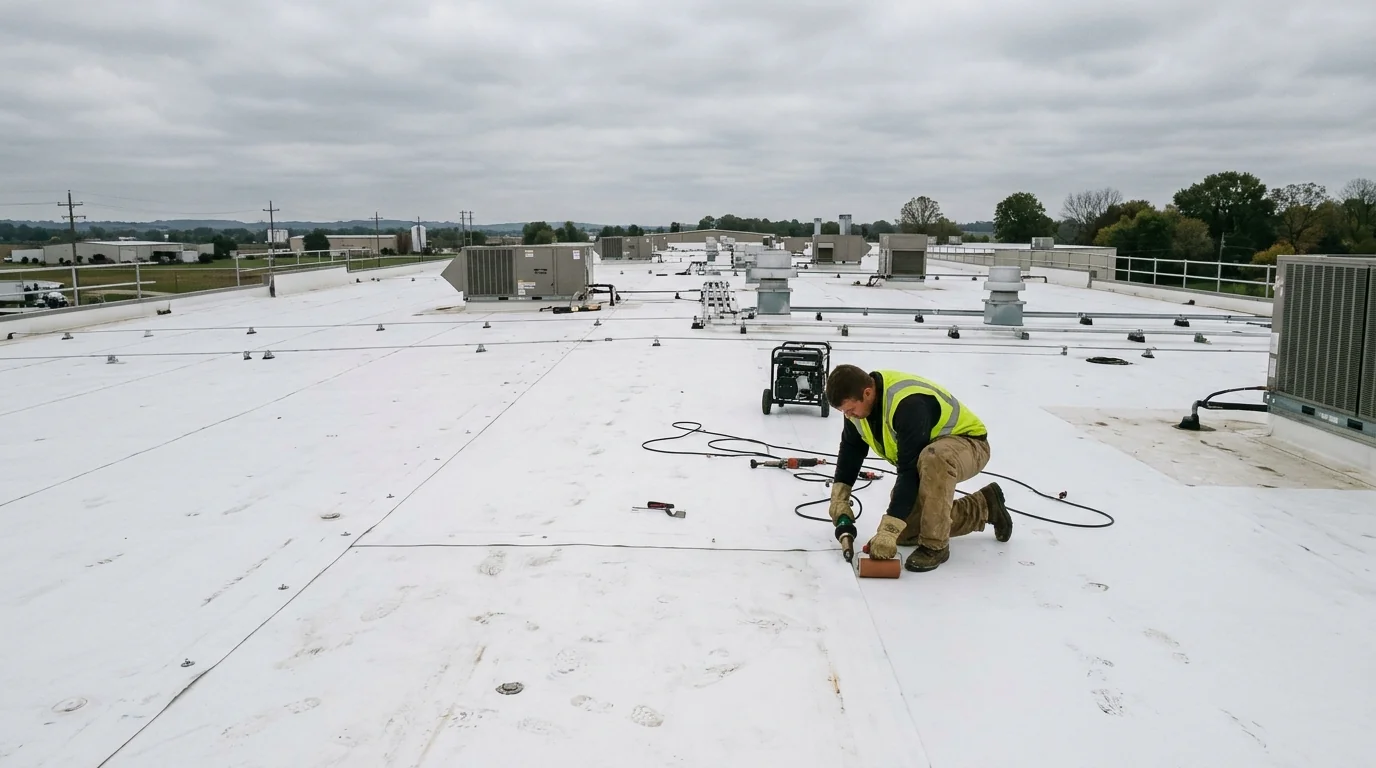
Most commercial roof repairs in the Dayton area cost $365 to $845 for a leak investigation and minor fix, and $685 to $2,260 for work like reflashing a rooftop unit curb or rebuilding a roof drain. Larger membrane section replacements typically run $9.45 to $16.85 per square foot. We repair TPO, EPDM, modified bitumen, built-up and metal roofs.
On a commercial building, a roof leak is rarely just a roof problem. It's a tenant calling about wet stock, a classroom with buckets on the floor, ceiling tiles falling into a sanctuary, or a hallway that has to be closed. Facility managers need two things fast: someone to stop the water, and a clear explanation they can pass up the chain. We set up our commercial repair work around both.
Our crews work on the low-slope roofs common across the Miami Valley: strip centers along busy corridors, warehouses near I-75, churches with additions from several eras, and schools with roofs ranging from new TPO to decades-old built-up. We identify the system, find the actual entry point, make a repair that's compatible with the existing roof and document it. If we see problems that will turn into leaks next season, we list them in order of urgency so you can plan the spending.
Problems facility managers should call about before they become leaks
Many commercial leaks give early warnings that a maintenance tech or custodian can spot. These are the ones we'd want to hear about.
Ceiling tile stains near rooftop units
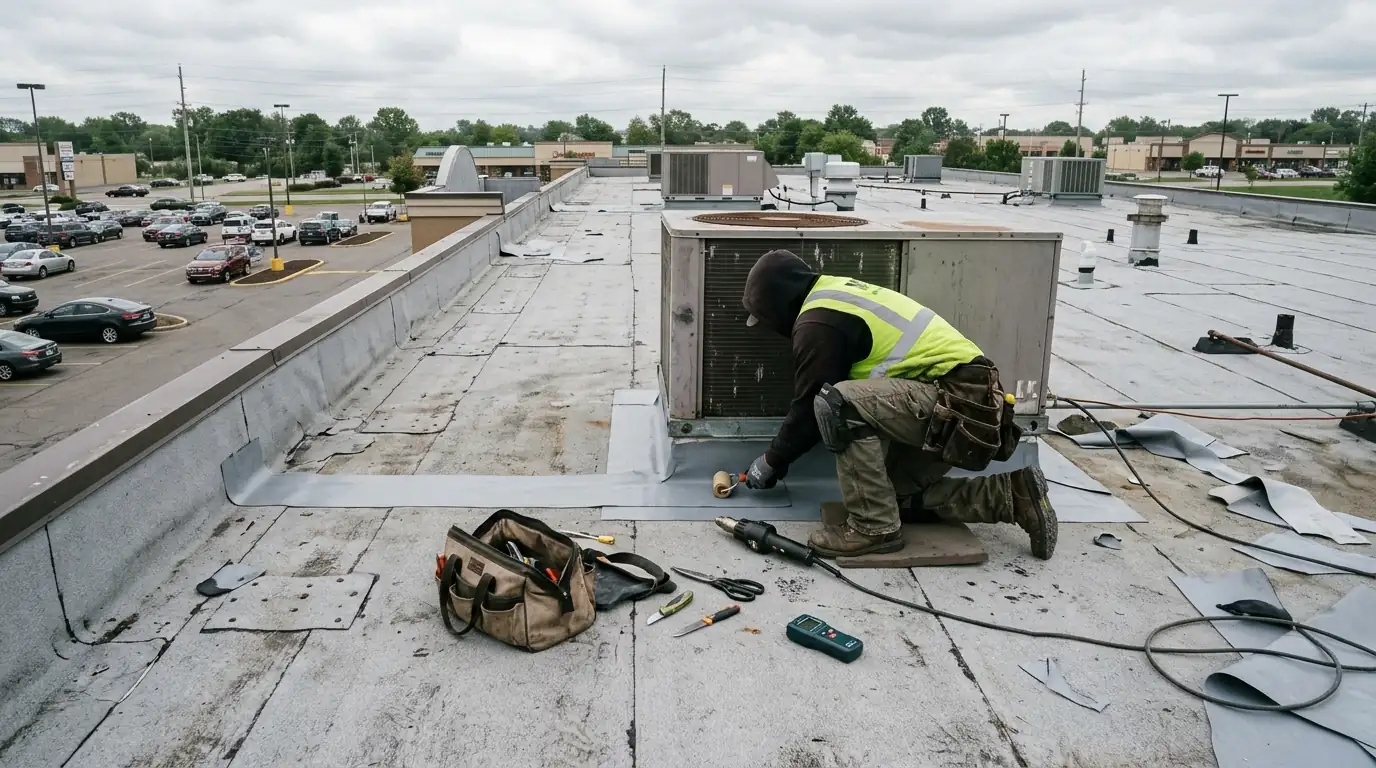
Curb flashings around HVAC units and exhaust fans are the most common leak points on commercial roofs, especially after equipment service.
Water backing up at drains or scuppers
Debris, failed strainers or sagging decks around drains let water stand and find weak laps nearby.
Loose or lifted metal coping
Parapet caps and edge metal loosened by wind let water into the wall and can peel back membrane in the next storm.
Wet insulation or a spongy roof surface
Soft areas mean water is already in the roof assembly, which adds weight and reduces insulation value.
Leaks after heavy rain from one direction
Wind-driven rain often points to parapet walls, masonry, expansion joints or window systems rather than the field membrane.
Damage after contractor work on the roof
New signage, solar mounts, satellite dishes and HVAC changes often leave unflashed penetrations or punctures behind.
From the first call to a repair report your owners can file
Our commercial repair calls follow the same sequence, whether it's a church at midnight or a distribution center on a Tuesday morning.
Triage over the phone
We ask where the water is showing, what's under it and how to access the roof, and we tell you what your staff can do inside while our roofer is on the way.
Stop the water
On arrival, the first goal is keeping water out of the building, with temporary patches, drain clearing or emergency membrane where needed.
Trace the source
We work outward from the leak location, checking curbs, drains, seams, coping and walls. Where needed, we use moisture meters, core samples or controlled water testing.
Repair with compatible materials
Repairs match the existing roof system so they bond correctly and don't create new problems. We check warranty paperwork first when a manufacturer's warranty is in place.
Document and report
You get a dated photo report showing the leak source, the repair and any other issues we noticed, written in plain language for owners and boards.
Prioritized recommendations
If other parts of the roof need work, we list them by urgency and estimate them separately, so you can schedule repairs within your budget cycle.
Commercial roof repair costs facility managers can plan around
These are typical Dayton-area ranges for common commercial roof repairs. Access, roof system and the extent of hidden damage drive most of the cost.
| Job | Typical range | What it covers |
|---|---|---|
| Leak investigation and minor repair | $365 to $845 | Service call, leak tracing, small patch, photo report |
| Rooftop unit curb reflashing | $685 to $1,940 | Remove old flashing, new membrane flashing and counterflashing |
| Roof drain rebuild | $790 to $2,260 | New drain flashing, clamping ring, strainer, sump repair |
| Metal coping or edge repair | $18.65 to $34.40 per linear foot | Resecure or replace coping, cleats and sealant |
| Membrane section replacement | $9.45 to $16.85 per sq ft | Remove wet insulation, new insulation, tie-in membrane |
| Semiannual maintenance visit | $385 to $1,265 per visit | Inspection, drain clearing, minor sealant, report |
These ranges reflect typical 2026 Dayton-area commercial repair costs and are not a quote; we confirm pricing after inspecting your roof. See more on our Dayton roofing price guide.
- Roof systemTPO, EPDM, modified bitumen, built-up and metal roofs each need different materials and techniques.
- Access and safetyInterior ladders and hatches are simple, while tall buildings may need lifts, perimeter protection or after-hours access.
- Hidden water damageWet insulation and deck corrosion often extend past the visible leak, so we confirm with cores before larger repairs.
- TimingAfter-hours, weekend and storm-night calls may cost more than repairs scheduled during normal working hours.
- Warranty requirementsSome manufacturer warranties require specific materials or notification, which can shape the repair method.
Repairs that keep a manufacturer's roof warranty intact
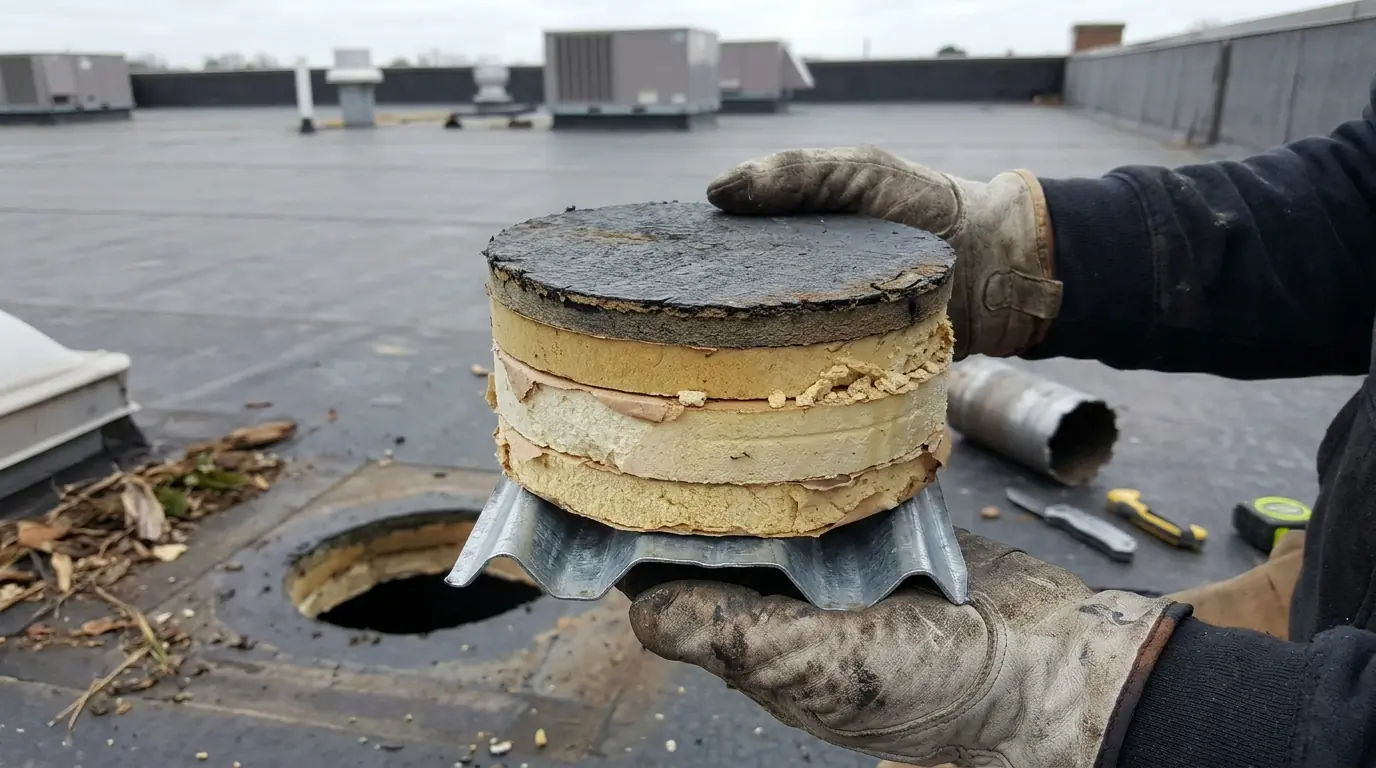
Many commercial roofs in the Miami Valley carry manufacturer warranties, and those warranties often come with conditions. Some require repairs to use the manufacturer's compatible materials, some require notification before work is done, and most exclude damage caused by unrelated trades. Before we cut into a warrantied membrane, we ask for the warranty paperwork and follow its repair requirements.
That matters even on small jobs. A mismatched patch on a TPO roof, or a sealant that isn't compatible with EPDM, can give a manufacturer a reason to deny a later claim. Our repair reports list the materials used and the location of each repair, which gives your building a record if a warranty question ever comes up. If your roof's warranty has expired, the same care still applies, because compatible repairs simply last longer.
- Have warranty paperwork and roof drawings ready if you can
- Tell us about recent HVAC, sign or solar work on the roof
- Keep our reports with your building maintenance records
Turning emergency calls into a repair budget you can plan
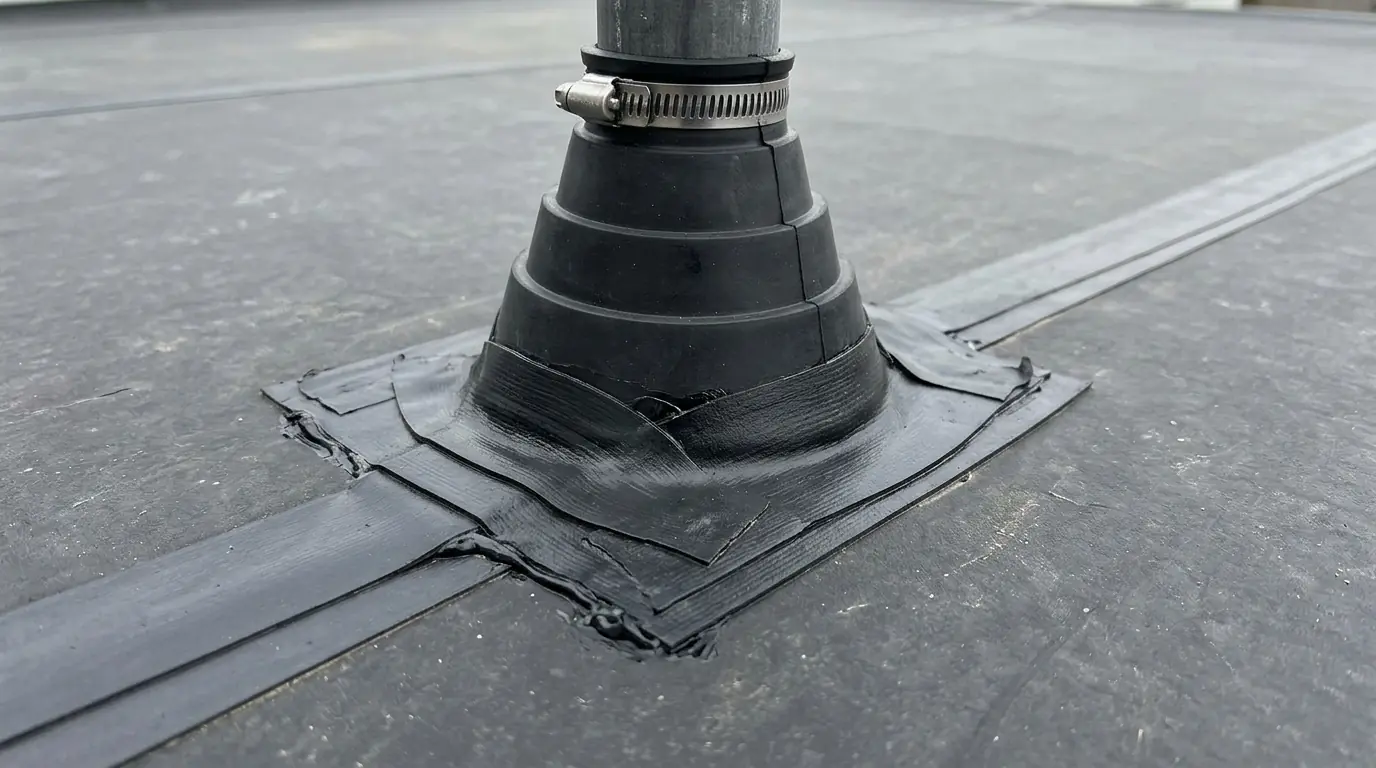
Most commercial roofs don't fail all at once. They develop a pattern of small leaks, often around the same curbs, drains and walls. If every repair is handled as an emergency, it's hard for owners to see the full picture. We prefer to help facility managers move from reactive repairs to planned work, with the cheapest, highest-risk fixes done first and bigger items grouped so a crew can handle several in one trip.
After a repair, our report includes a short list of the next most likely problem areas and rough cost ranges for fixing them. Pairing that with spring and fall maintenance inspections gives your board or ownership group a timeline: what needs attention this year, what can wait and when commercial roof replacement should enter the capital plan. For churches and schools, that kind of planning often makes the difference between a manageable line item and a surprise assessment.
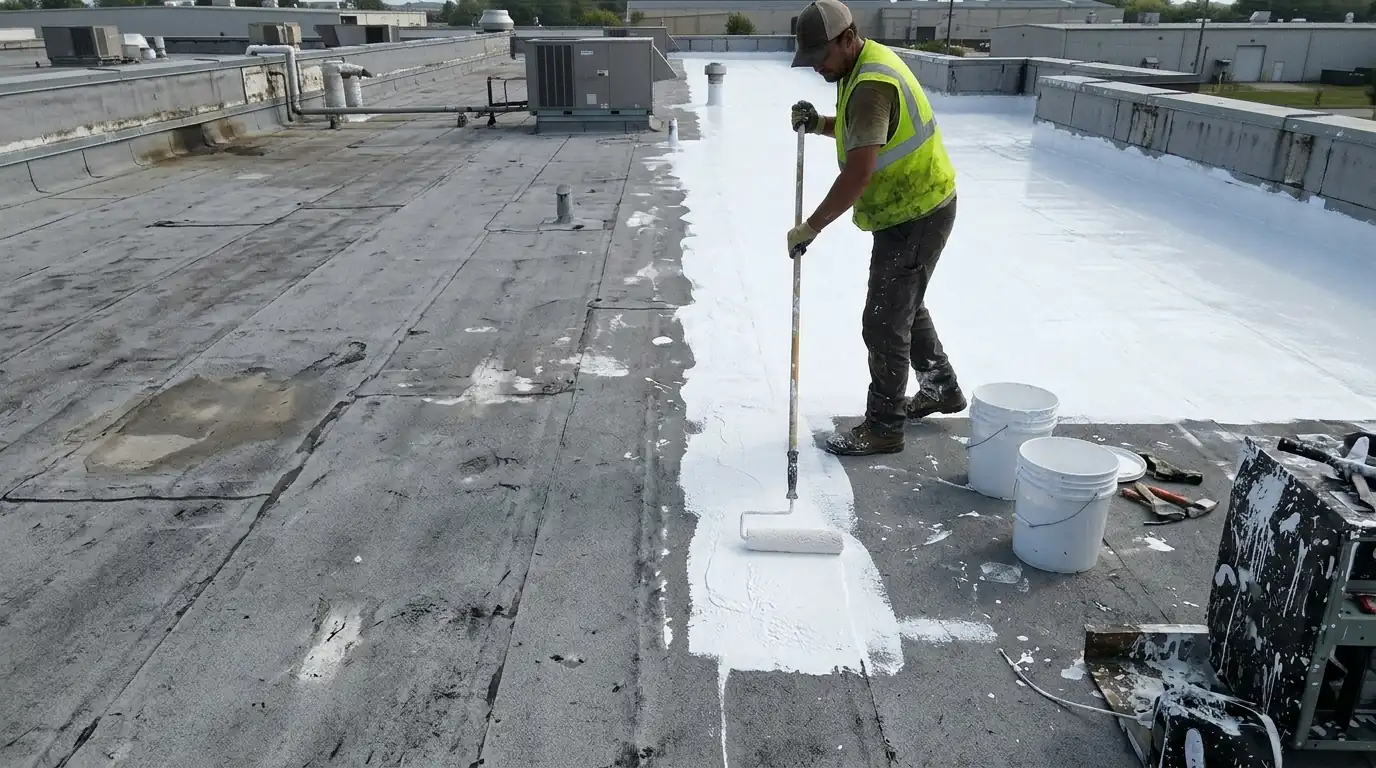
Commercial roof repairs across Dayton's retail, industrial and institutional buildings
The Memorial Day 2019 tornado outbreak damaged many commercial, church and apartment roofs in Old North Dayton, Northridge, Harrison Township, Trotwood and Huber Heights. Some of those buildings were fully reroofed afterward, while others were repaired in sections, and those mixed roofs need careful attention where old and new materials meet. Patched transitions between a newer TPO section and an older built-up section are a frequent source of repeat calls.
Elsewhere in the region, we see the same patterns. Strip centers with restaurant tenants deal with grease-damaged membranes and crowded rooftop equipment. Warehouses and light industrial buildings along I-75 and in the Miami Valley's industrial parks have big roofs where a few clogged drains can cause ponding over large areas. Churches and schools often have several roof sections from different decades, each with a different system and different failure points. Freeze-thaw winters open flashing seams, spring storms test drains, and summer heat ages older membranes, so we plan repairs with all three seasons in mind.
Where we do commercial roof repair most often
These neighborhoods, suburbs and cities make up most of our commercial roof repair calls. Each link opens the local page with its ZIP.
Questions about commercial roof repair in Dayton
Can you repair our store's roof leak without closing the sales floor?
In most cases, yes. Repairs happen on the roof, and inside we usually need only a small area for leak tracing or protecting merchandise. We can schedule noisy work like core cuts or curb reflashing before opening or after closing. If work needs to happen above a busy area, we coordinate with your staff so customers aren't under any risk.
What documentation do you give a property owner after a commercial roof leak repair?
You get a dated photo report showing the leak area inside, the source we found on the roof, the repair in progress and the finished work. We note materials used, the location on a simple roof sketch and any other issues worth watching. The report is written plainly so property managers can forward it to owners, boards or insurance adjusters without rewriting it.
Will a repair void the manufacturer warranty on our existing commercial roof?
Not if it's done according to the warranty's terms. We review the warranty before work, use compatible materials and follow any notification requirements. Problems arise when unrelated contractors patch with the wrong products or cut into the roof without proper flashing. If your building has a warranty, send us the paperwork when you call so we can plan the repair correctly.
How should a church facilities committee budget for ongoing flat roof repairs?
Start with a condition assessment that separates urgent repairs from items that can wait. Many church buildings have several roof sections, so budgeting by section makes sense. We recommend setting aside funds for spring and fall inspections, a modest annual repair allowance and a long-term replacement fund for the oldest section. Our reports give committees a starting point for those discussions.
What should our maintenance staff do inside while waiting for your roofer to arrive?
Move inventory, electronics and files away from the leak, set buckets or tarps, and if water is near light fixtures or electrical panels, shut off power to that area if it's safe. Take photos of the leak and any damage. Don't send staff onto the roof during a storm. When our roofer arrives, those photos help speed up leak tracing.
How often should a warehouse roof near I-75 be inspected?
We recommend at least two inspections a year, in spring and fall, plus checks after major storms. Large warehouse roofs can hide clogged drains, punctures from service work and loose edge metal that aren't visible from the ground. Buildings near highways and industrial sites also collect more dust and debris, which can block drains and dull reflective membranes faster.
Other roofing work that often goes with this job
Product lines we install on roofs around Dayton include shingles from GAF, Owens Corning and CertainTeed, metal from Englert, membranes from Carlisle SynTec and skylights from VELUX.
Need commercial roof repair today?
Call any hour. A person answers, asks a few questions and sets a time for a roofer to come out.