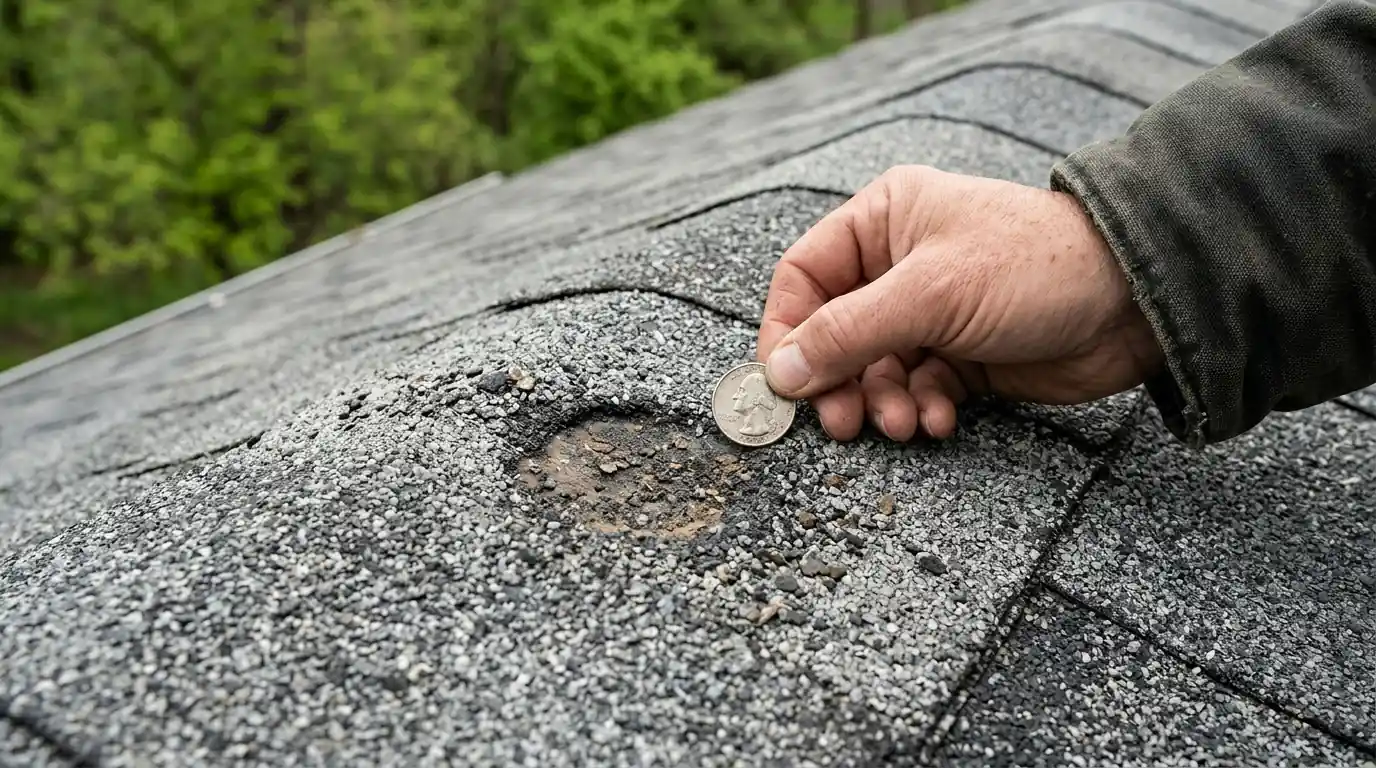
Hail damages asphalt shingles by knocking off granules and cracking the fiberglass mat underneath, usually without leaving a visible hole. In the Dayton area most damaging hail falls from April through July. Hail around one inch or larger can bruise newer architectural shingles, and older roofs can be hurt by smaller stones. A close roof inspection within a few weeks of the storm is the only reliable way to know.
When hail season really hits the Miami Valley
Our hail season runs roughly from April into July, with the heaviest storms usually landing in May and June. Storm lines that build over Indiana often reach Dayton by late afternoon. Those storms tend to track southwest to northeast, which is why a swath can cross Englewood and Vandalia, skip downtown, and drop again over Huber Heights or Fairborn.
Hail swaths are narrow. We regularly see one side of a subdivision with bruised shingles while the streets a half mile away came through clean. The questions that matter are how big the stones were on your street, how long they fell, and how hard the wind was blowing while they came down.
What a hailstone actually does to an asphalt shingle
An architectural shingle is a fiberglass mat soaked in asphalt and covered with ceramic-coated granules. The granules are the shingle's sunscreen. When a hailstone hits, it can knock a patch of granules loose, crush the asphalt underneath, or crack the mat itself. From the driveway, a bruised shingle usually looks perfectly normal.
The trouble starts later. Once granules are gone, ultraviolet light bakes the exposed asphalt, and that spot dries, shrinks and cracks faster than the shingle around it. A fractured mat lets water wick in during the next soaking rain. This is why so many hail leaks in the Dayton area show up in August, or during the following spring's freeze-thaw cycles, rather than the week after the storm.
Hail also dents aluminum vents, pipe boot collars, skylight frames and gutters, and a cracked plastic vent cap leaks just as surely as a cracked shingle.
Why your roof and your neighbor's roof can tell different stories
Two houses on the same street can come through one storm with very different damage. The biggest reasons are shingle age, shingle type and which way each slope faces. A fifteen-year-old roof in Kettering has lost much of its flexibility, so pea-sized hail that bounces off a new roof can crack it.
Wind matters as much as stone size. During most of our spring storms the hail comes in at an angle from the west or northwest, so those slopes take the beating while the east slope looks untouched.
What you can check from the ground in the first week
You don't need to climb a ladder to gather useful evidence, and we'd rather you didn't on a wet roof. Walk the property within a day or two of the storm and take dated photos of anything that looks off. Soft metals are the best witnesses, because they show dents clearly and they don't lie about stone size.
- Gutters and downspouts: look for round dents, and note which sides of the house have them.
- Air conditioner fins: flattened rows on the condenser often point to the hail's direction.
- Window screens and wood trim: torn screens or fresh dings in paint on one side of the house.
- Granules in the downspout splash: a small pile of dark sand at the outlet after the first rain.
How we inspect a roof after a hail report
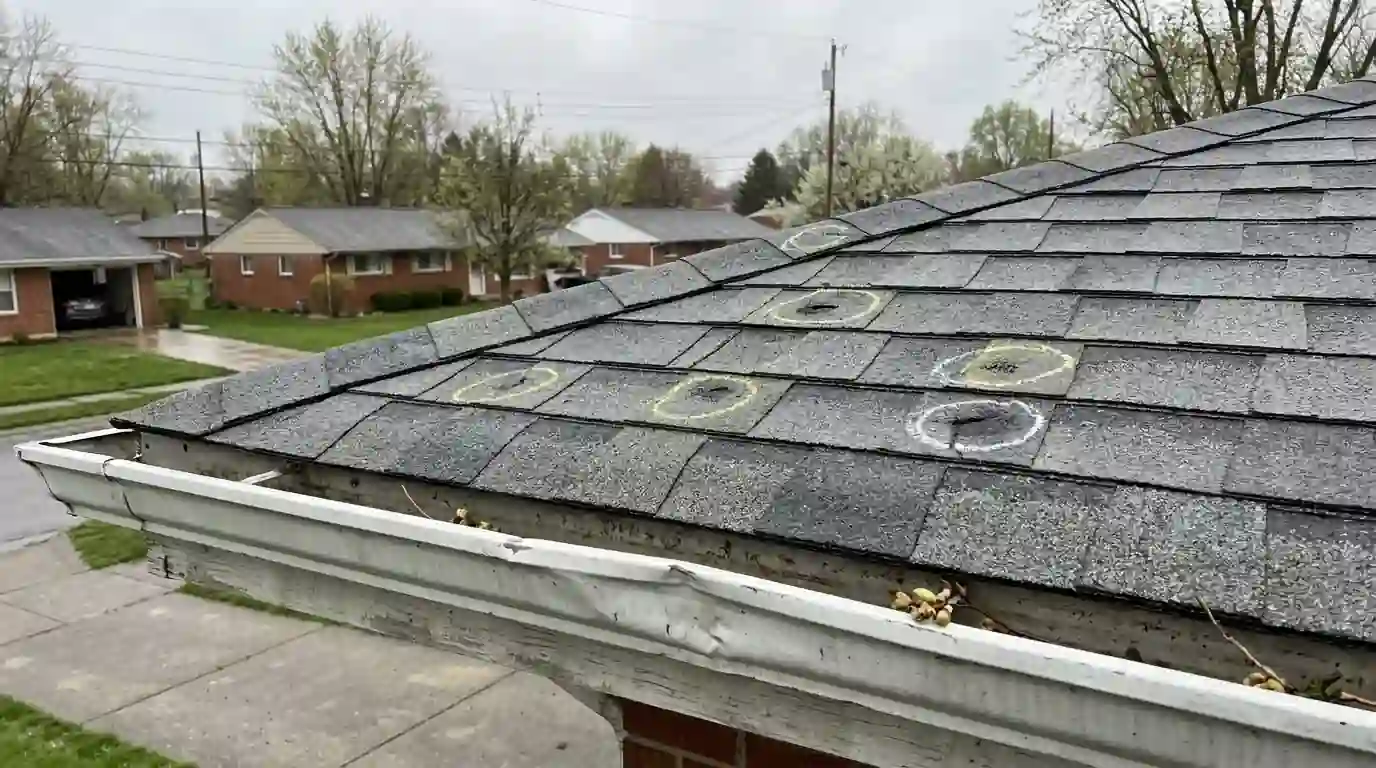
On the roof, we work slope by slope. Our roofers mark a ten by ten foot test area on each slope and count hits, circling each bruise in chalk so it shows clearly in photos. We press on suspect spots, because a true hail bruise feels soft, like pressing a bruised apple. We'll tell you when something is wear and not hail.
We photograph the vents, flashing, gutters and any skylights, then put it all into a photo report with a plain summary of what we found and what we'd recommend. If the damage looks claim-worthy, our insurance claim inspection documents it the way adjusters expect to see it. If it doesn't, we say so, even if it means there's no job for us.
Repair, slope replacement or a new roof: honest Dayton costs
Scattered damage on a younger roof can often be fixed with targeted hail damage repair. Replacing a handful of bruised shingles plus a cracked vent typically runs $385 to $1,240 in the Dayton area, depending on roof pitch, access and whether the shingle line is still made. Matching is the catch. Shingle colors get discontinued, and a patch of new shingles on an older roof can look like a quilt.
When one or two slopes are heavily hit, replacing those slopes may make sense, though many homeowners and adjusters end up preferring a full replacement for a uniform look. A full tear-off on a typical 1,800 to 2,400 square foot Dayton home with architectural shingles commonly lands between $11,650 and $19,480, depending on layers, decking repairs and pitch. Our typical roofing prices page breaks those factors down further.
If you're replacing anyway, it's worth pricing impact-resistant shingles rated Class 4. On a typical home the upgrade usually adds $1,180 to $3,460 over a standard architectural shingle. Some insurers give a premium discount for them, and some don't, so call your agent before you count on savings.
Timing, claims and the trucks that show up after a storm
Most homeowners policies set a deadline for reporting storm damage, commonly one or two years from the storm date, and some are shorter. Waiting also makes it harder to tie damage to a specific storm, especially in a year with several hail days. Get the roof looked at within a few weeks, even if you plan to decide later.
After a big storm, out-of-town crews often knock on doors across Beavercreek, Centerville and Huber Heights. Some are fine. Some disappear before the warranty questions start. Ask for a local address, get everything in writing, and never sign anything that hands over your insurance payment before you've seen a written scope. Our step-by-step guide to Ohio storm claims walks through the order of events. If you'd like us to take a look, call any hour and a person answers.