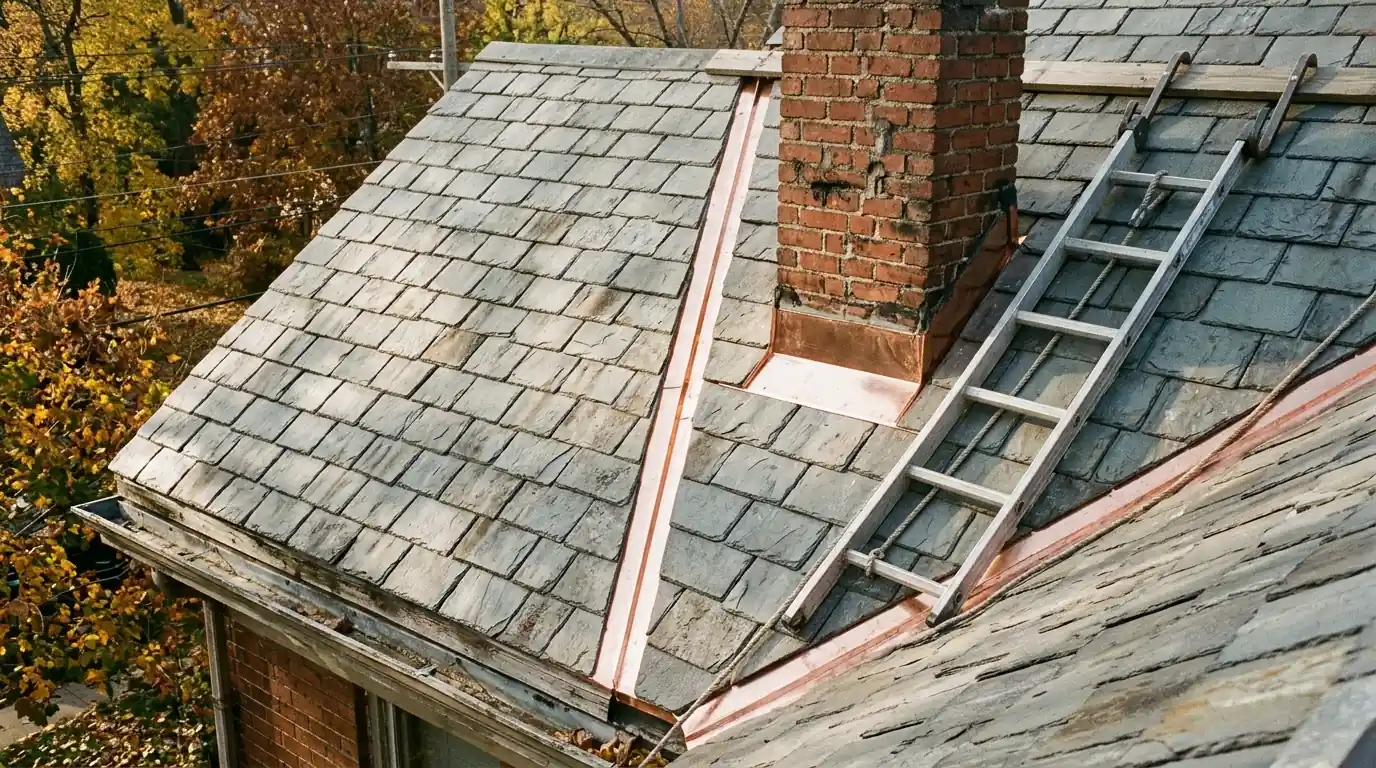
Good slate can last 75 to 150 years, but nails, flashing and built-in gutters usually wear out first. Caring for a slate roof means replacing broken pieces with matching slate and copper hooks, rebuilding flashing in copper when it fails, keeping people off the roof, and never sealing anything with tar. Most historic Dayton slate roofs deserve repair long before replacement.
Where slate roofs show up around Dayton
Slate was a common roofing choice for well-built homes in the Dayton area from the 1880s through the 1930s. You'll find it across Oakwood, in the Dayton View Triangle and Grafton Hill, on many of the Victorian and Italianate houses in St. Anne's Hill and South Park, and on older churches and schools throughout the city. Tudor Revival and Colonial Revival homes from the 1920s carry a lot of it too.
Most of what we see came by rail from Pennsylvania and Vermont. Pennsylvania slate is typically gray-black and on the softer side. Vermont and New York slates come in grays, greens, purples and reds, and many are harder and longer lived. Knowing which you have matters, because it changes how much life the roof has left and which salvaged slate will match.
What wears out first on an old slate roof
The stone is usually the last thing to go. On a 100 year old roof, the slates themselves may have decades left while the iron nails holding them have rusted thin. When nails fail, slates slip out of place one at a time, which is why you'll sometimes find a single gray rectangle lying in the flower bed after a windy night.
Flashing is the next weak point. Original flashing on many Dayton slate roofs was terne-coated steel or copper. Terne rusts through without regular painting, and even copper wears thin in valleys after 70 or 80 years. Built-in box gutters, hidden behind the cornice on many older homes, are another common leak source. When their lining fails, water runs straight into the wall and the soffit, not onto the roof.
- Soft slate: often 60 to 90 years before flaking and delamination set in.
- Hard slate: commonly 100 to 150 years or more with good care.
- Copper flashing: frequently 60 to 80 years, longer on lower-stress areas.
- Iron nails: the most common reason sound slate starts slipping.
How our weather and people damage slate
Freeze-thaw cycles are hard on softer slate. Water soaks into the layers, freezes on a January night and pushes them apart a little more each winter. Over time the face flakes away and the slate turns chalky, often first along the drip line where water lingers. Hail cracks slate occasionally, and falling limbs from the big oaks common in older neighborhoods break it outright.
People cause more damage than weather, though. Slate is strong against rain but brittle underfoot, and one careless walk across a roof can crack a dozen pieces. Satellite installers, gutter cleaners, chimney sweeps and well-meaning handymen are frequent culprits. So are bad repairs. Roofing cement smeared over cracked slates or loose flashing traps water, makes later repairs harder and rarely holds more than a few seasons.
What proper slate repair looks like
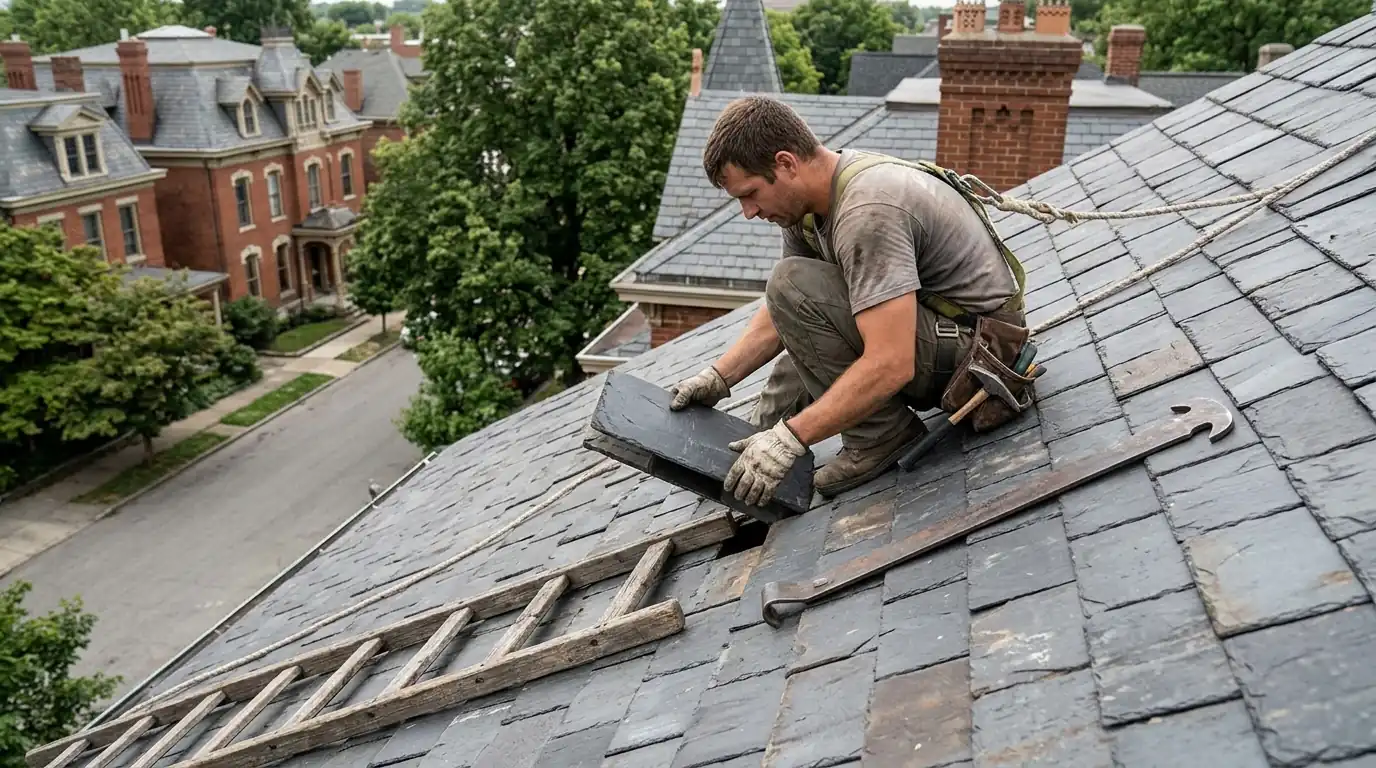
On a slate roof, we work from ladders, roof hooks and staging rather than walking directly on the stone. To replace a broken slate, we use a slate ripper to cut the old nails without disturbing the slates above it. The replacement is a matching salvaged slate or a close new match, set with a copper slate hook or a nail-and-bib method that keeps the fastener covered and dry.
Flashing gets rebuilt in copper, which will last as long as the slate around it. Around a chimney, that means new step and counterflashing cut into the mortar joints, not caulked to the brick face. Our chimney flashing work on slate roofs follows that same approach. Valleys get new copper liners. Box gutters are relined in copper or a durable membrane, depending on budget and visibility.
Typical Dayton-area costs vary widely with roof height and access. Replacing a handful of broken slates commonly runs $385 to $1,240 per visit. Rebuilding chimney flashing in copper on a slate roof often lands between $1,650 and $4,380. Relining box gutters typically runs $38 to $87 per linear foot, depending on the material and how much rotted wood we find underneath.
A simple yearly care routine for slate owners
Slate rewards light, regular attention. You don't need to climb anything to keep tabs on it, and we'd much rather you stayed on the ground. A pair of binoculars and fifteen minutes each spring catch most problems early.
- Scan each slope in spring and after major storms for missing, slipped or cracked slates.
- Look for rust streaks below flashing and discoloration around the chimney.
- Check the attic after heavy rain for damp boards, especially near valleys and the chimney.
- Keep box gutters and downspouts clear, ideally cleaned by someone experienced with slate.
- Trim overhanging branches before they rub or drop on the roof.
- Ask anyone going on the roof how they plan to work without walking on the slate.
Restore, relay or replace: making the big call
Most slate roofs we inspect in Dayton need targeted repairs, not replacement. When repairs start stacking up, the next question is whether the slate itself is sound. If the stone rings when tapped and holds together, but nails are failing widely, the roof can be stripped, given new underlayment and copper flashing, and relaid with the original slate plus salvaged matches. That's major work, but it preserves an irreplaceable roof.
When a large share of the slate is soft, flaking or cracked, replacement becomes the honest recommendation. New natural slate is the most authentic choice and also the most expensive. Synthetic slate costs less and weighs less, and some products look convincing from the street. In Dayton's historic districts, any change of material generally goes through design review, so talk to the city's preservation staff before you plan around a substitute. For a roof-wide condition check, our slate repair and restoration visit includes photos of every slope. It goes deeper than a typical shingle roof inspection because slate needs closer attention.