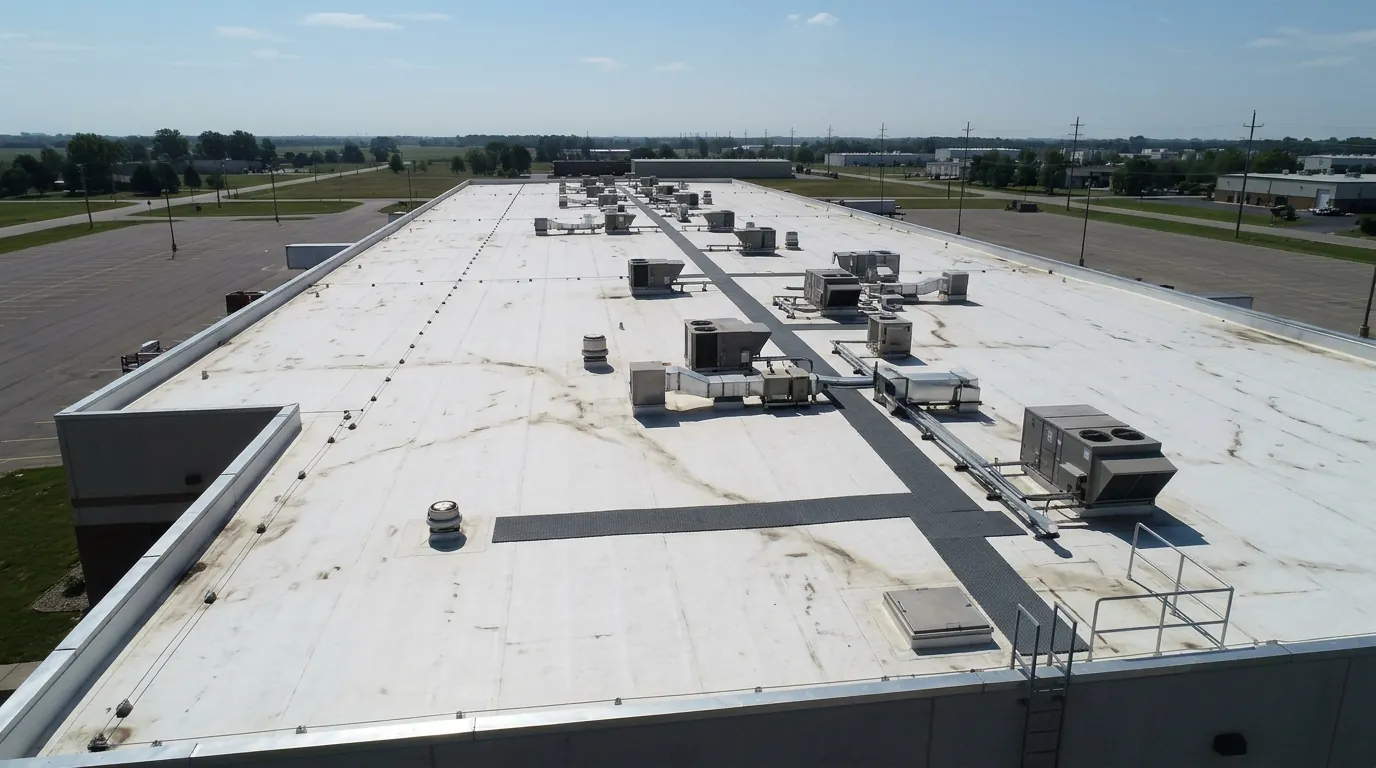
For most Dayton commercial buildings, the realistic choices are TPO, EPDM, modified bitumen, or a silicone coating over a sound existing roof. Typical installed costs run about $6.90 to $13.60 per square foot for new membranes and $3.15 to $5.40 for coatings. The right pick depends on drainage, foot traffic, rooftop equipment, budget and how long you plan to own the building.
What's on Dayton's commercial roofs right now
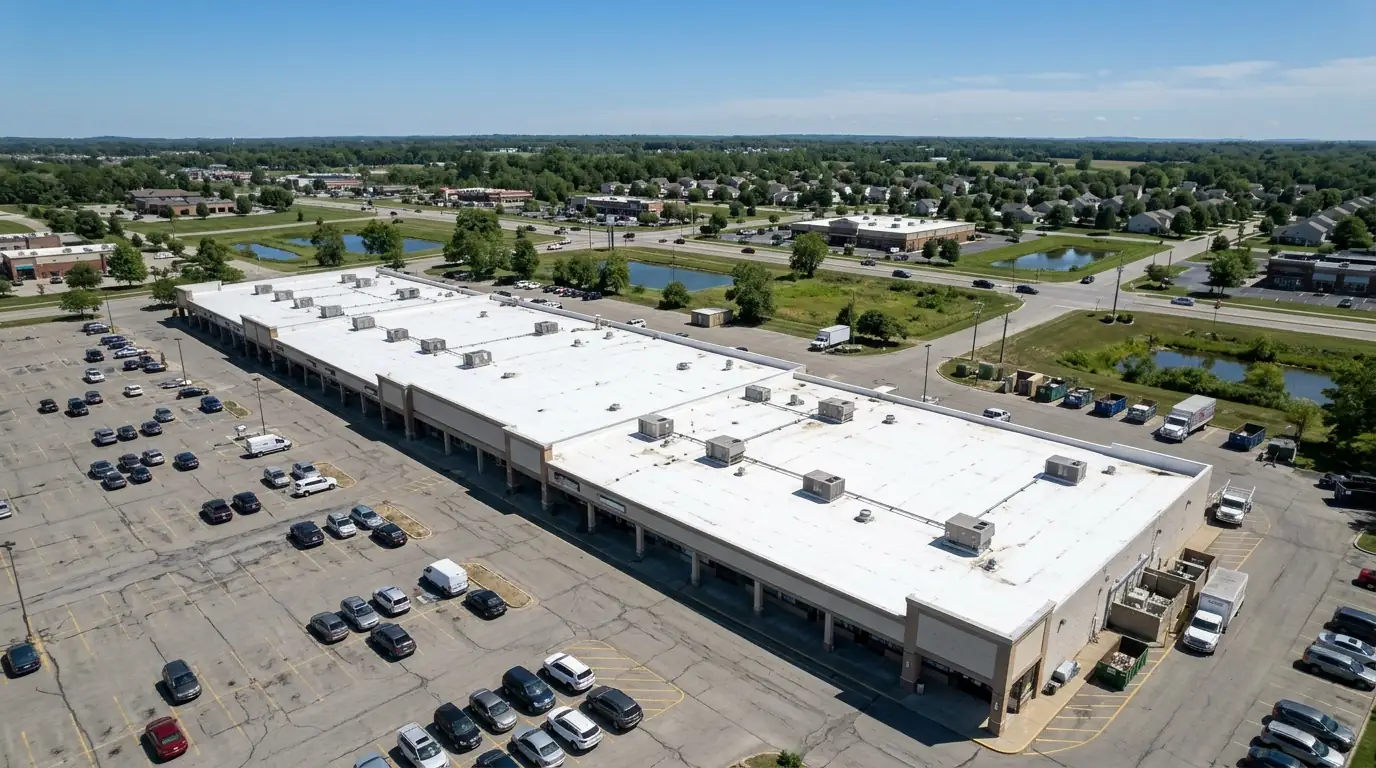
The low-slope roofs we see across the Miami Valley tell the story of when each building went up. Strip centers from the 1960s and 1970s along the main suburban corridors often still carry built-up tar and gravel, sometimes with a newer membrane laid over it. Warehouses and flex buildings near the airport, in Moraine and out toward Vandalia tend to have EPDM, TPO or older modified bitumen. Downtown masonry buildings usually have parapet walls, internal drains and several generations of patches.
Each of those starts from a different place. A 40,000 square foot warehouse with a simple layout and few penetrations is a very different job from a two-story brick building on a tight downtown lot with a restaurant's kitchen exhaust on the roof. Before we talk materials, we walk the roof, map the drains and core a few spots to see what's actually under the surface.
The main options compared, with typical Dayton costs
These are typical 2026 installed ranges for the Dayton area, not quotes. Building height, access, insulation, tear-off layers and the number of penetrations all move them.
- TPO: a white, heat-welded single-ply membrane. Typically $8.40 to $13.60 per square foot. Reflective, with strong welded seams.
- EPDM: black rubber with taped or glued seams. Typically $7.85 to $12.70 per square foot. Proven, flexible in cold weather, easy to patch.
- Modified bitumen: layered asphalt sheets, torch-applied or self-adhered. Typically $6.90 to $11.80 per square foot. Tough under foot traffic.
- Silicone coating: a fluid-applied layer over a sound existing roof. Typically $3.15 to $5.40 per square foot. Renewable, but only as good as the roof beneath it.
How each system handles Miami Valley weather
Our weather is hard on low-slope roofs in a few specific ways. Ponding water is the big one. Water that sits for more than a couple of days after a rain freezes and thaws repeatedly in winter, grows algae in summer and finds every weak seam. Any membrane will eventually leak under chronic ponding, so drainage comes before product choice.
Summer heat and UV punish dark surfaces. A white TPO or silicone surface stays much cooler on a July afternoon than black EPDM or a gravel roof, which can lower cooling costs on an air-conditioned building. In winter, EPDM rubber roofing stays flexible in the cold and tolerates the building movement older structures go through.
Hail and wind matter too. Thinner membranes can be punctured by large hail, especially over soft insulation, so we often recommend a cover board on buildings in open areas. Perimeter edges and corners take the most wind uplift, and that's where we use heavier attachment and solid metal edge details.
Tear off, recover or restore: the honest tradeoffs
A full tear-off costs the most, but it gives you a clean slate. We can fix rotted deck, add tapered insulation to correct ponding, and bring the insulation up to current energy code, which lowers heating bills for the next 20 years. It's the right call when the existing roof is wet, has multiple layers already or has failed over large areas.
A recover, where a new membrane goes over the existing roof, saves the tear-off cost. Code generally allows it when the existing roof is dry and only one roof exists, but wet insulation trapped underneath will rot the deck and void most warranties. That's why we run a moisture survey before recommending one.
A silicone coating makes sense when the roof is sound, mostly dry and simply aging. It extends life by 10 to 15 years and can usually be renewed later. It won't fix structural ponding, saturated insulation or a deck that's already soft. When a coating salesman says otherwise, ask to see the moisture scan.
Drainage and details that decide how long any roof lasts
The membrane gets the attention, but most leaks we trace on Dayton commercial roofs start at details. Drains that sit higher than the surrounding roof, clogged scuppers, cracked parapet coping, and loose flashing at rooftop unit curbs are the usual suspects. Pitch pans filled with old sealant around gas lines and conduit are another favorite.
On replacement work, we add tapered insulation and crickets to move water toward drains, raise or replace drain bodies, and rebuild parapet flashing and coping. We also add walkway pads to service paths so HVAC technicians don't wear holes in the membrane on their way to the units.
Whatever system you choose, a twice-yearly walk keeps it working. We recommend one in late spring after hail season settles and one in late fall after the leaves drop, since a single clogged drain can turn a dry roof into a pond within one storm. Those visits are also when we catch small punctures, open laps and failed sealant early, while commercial roof repair is still a small invoice instead of a ceiling tile replacement and an unhappy tenant.
Budgeting, timing and keeping tenants open
Plan for typical service lives in our climate: roughly 15 to 25 years for TPO, 20 to 30 years for EPDM, 15 to 20 for modified bitumen, and 10 to 15 for a coating before it needs renewing. Owners who budget a reroof three to five years ahead have time to compare options and avoid emergency pricing after a leak shuts down a tenant.
Installation season matters. Most adhesives and coatings need dry weather and temperatures above about 40 to 50 degrees, so our busiest commercial season runs April through October. Winter work is possible with heat-welded TPO and mechanically attached systems, with some limits. For a closer look at your building, our commercial roof replacement team can walk the roof with you and lay out repair, recover and replacement options side by side. Call any hour if water is already coming in.